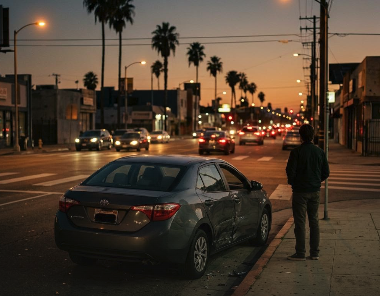
What Should I Do After a Hit-and-Run Accident in California?
When the other driver leaves the scene, the steps you take next can become especially important for documenting what happened and identifying potential insurance coverage.
CD LAW · LOS ANGELES PERSONAL INJURY
LOS ANGELES · AFTER DARK
THE OTHER DRIVER LEFT
THE CAR IS GONE. THE ACCIDENT ISN'T.
A DIFFERENT KIND OF COLLISION
A hit-and-run can leave an injured person with questions that are different from those involved in an ordinary collision.
Who pays for the damage? What happens if the driver is never found? What evidence can still be collected? What insurance coverage may apply?
The first priority is safety. After that, documenting what happened can become especially important.
IMMEDIATELY AFTER THE CRASH
What Should You Do After a Hit-and-Run Accident?
01
GET TO A SAFE LOCATION
If possible, move out of immediate danger and evaluate whether anyone needs emergency medical assistance.

02
CALL 911 WHEN APPROPRIATE
Report the collision and request emergency assistance when necessary.
03
DO NOT CHASE THE DRIVER
Do not create another dangerous situation by attempting to pursue the fleeing vehicle.
04
REMEMBER WHAT YOU SAW
Write down anything you remember about the vehicle or driver as soon as possible. Potential details include color, make or model, body style, visible damage, direction of travel, a partial license plate or a driver description.
05
DOCUMENT THE SCENE
Photograph the vehicles, damage, roadway, debris, surroundings and other relevant conditions when it is safe to do so.
06
LOOK FOR WITNESSES
Someone nearby may have seen something you missed. Note names and contact information when possible.
07
LOOK FOR CAMERAS
Nearby businesses, residences, parking facilities or traffic areas may have recorded relevant footage.
YOU DON'T NEED THE WHOLE LICENSE PLATE FOR INFORMATION TO MATTER.
A partial plate number, vehicle description, direction of travel, witness account or nearby camera may provide useful information.
WHAT CAN DISAPPEAR
Evidence Can Become Harder to Find With Time
The relevance of each type of evidence depends on the circumstances. Some details are easiest to preserve close to the time of the collision; surveillance footage, in particular, should never be assumed to exist or remain available.
01
WITNESSES
02
CAMERA FOOTAGE
03
PHOTOGRAPHS
04
VEHICLE DAMAGE
05
DEBRIS
06
POLICE INFORMATION
07
MEDICAL RECORDS
08
INSURANCE INFORMATION
THE DRIVER MAY BE GONE. OTHER EVIDENCE MAY STILL BE THERE.
THE INSURANCE QUESTION
Who Pays When the Hit-and-Run Driver Cannot Be Found?
Potential recovery depends on the circumstances and available insurance coverage. Uninsured motorist coverage may be relevant. Collision coverage, medical-related coverage that may apply, and other potentially applicable insurance can also matter depending on the policy and facts. Coverage does not automatically apply, and the specific language and circumstances should be considered.
YOUR OWN POLICY MAY MATTER
THE DRIVER DISAPPEARED. YOUR INSURANCE COVERAGE DIDN'T.
When the responsible driver cannot be identified or does not have available insurance, an injured person's own insurance policy may become an important part of the analysis. Whether coverage applies depends on the policy and circumstances.
IDENTIFICATION
What Happens If the Hit-and-Run Driver Is Later Identified?
Identifying the driver may provide additional information about liability, insurance coverage, vehicle ownership and potential claims. Finding the driver does not guarantee compensation; the facts and available coverage still matter.
DON'T IGNORE THE MEDICAL SIDE
What If You Were Injured in the Hit-and-Run?
Some accident-related symptoms may not be fully understood immediately after a collision. A medical evaluation may help document injuries, treatment and symptoms, along with medical expenses, missed work and limitations.
IF YOU REMEMBER ONLY ONE THING
DON'T CHASE THE CAR. PRESERVE THE EVIDENCE.
LOS ANGELES HIT-AND-RUN CLAIMS
Hit-and-Run Accidents Can Happen Anywhere in Los Angeles
Crowded intersections, freeway entrances and exits, neighborhood streets, parking areas and heavily traveled surface streets can all present different conditions. The important questions involve evidence, injuries, insurance coverage and whether the responsible driver can be identified.
SAVE THIS LIST
Hit-and-Run Accident Checklist
□01Get somewhere safe
□02Call emergency services when necessary
□03Report the accident
□04Write down what you remember
□05Photograph the scene
□06Photograph vehicle damage
□07Identify witnesses
□08Look for nearby cameras
□09Preserve medical documentation
□010Notify the appropriate insurance carrier
□011Keep accident-related records organized
COMMON QUESTIONS
California Hit-and-Run Accident FAQs
AFTER A HIT-AND-RUN
You May Still Have Options Even When the Other Driver Leaves.
If you were injured in a hit-and-run accident in Los Angeles or Southern California, CD LAW can review the circumstances, available evidence and potentially applicable insurance coverage and help you understand your legal options.